
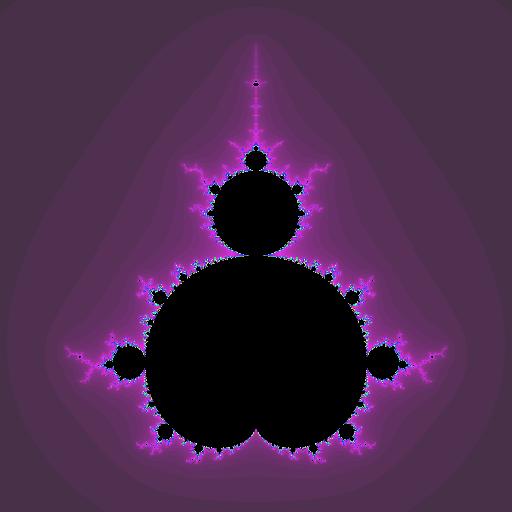
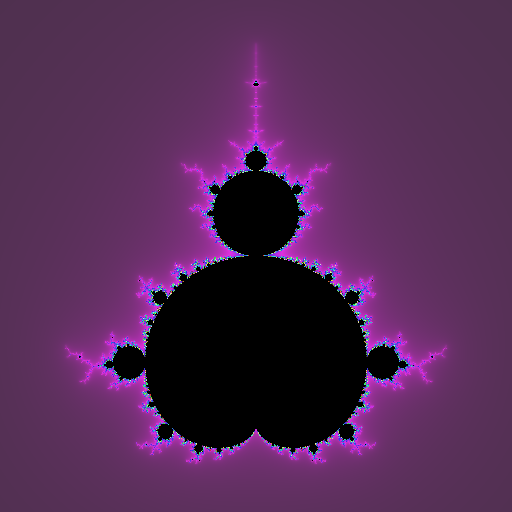
This is a large-scale rendering of the Buddhabrot: 1,048,576 x 1,048,576 pixels (220 on a side, about 1.1 trillion pixels in all), browsable like a map. The switcher in the top right offers three views of the same underlying object: two colorings of the Buddhabrot, and the classic Mandelbrot set.
The Mandelbrot set is a fractal (the
Wikipedia article goes
deep), but put simply: for every point c of the plane, run the formula
z = z² + c over and over, starting from zero. If the value of
z ever escapes past a fixed distance from the origin, c is
outside the set; if it stays bounded forever, it is inside. Painting inside points
black and outside points white gives the first image.
The same data allows for richer pictures. Coloring each outside point by how many iterations it took to escape gives the banded second image. Picking colors from a smoothly cycling palette, and smoothing further by how far past the threshold the value lands, gives the third -- which is exactly the "Mandelbrot" view on the map.
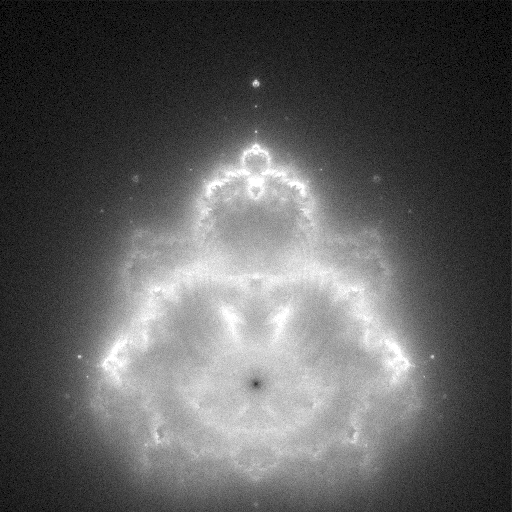
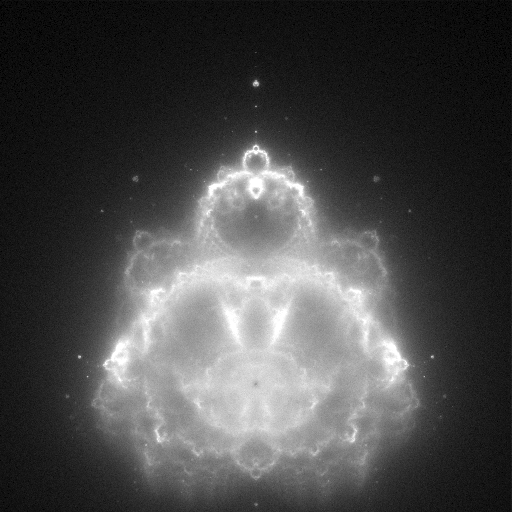
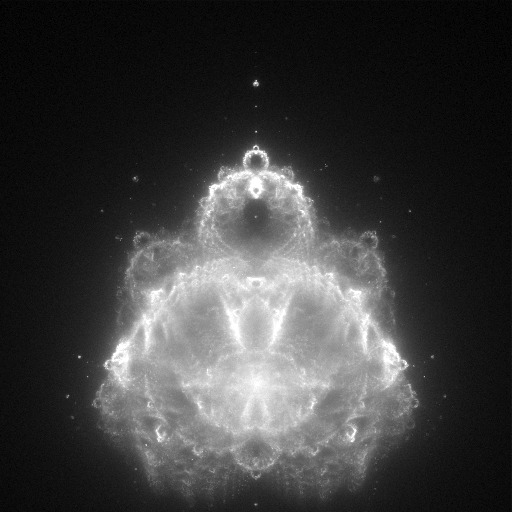
The Buddhabrot is an alternative way of viewing the same iteration. Instead of
coloring c by how quickly it escapes, follow the point z
on its way out and brighten every pixel it passes through. Summing those visits over
billions of random starting points produces a density image: the Buddhabrot.
One interesting property is that the image depends on how many iterations you are willing to compute before giving up on a point. The three images above allow orbits up to 100, 500, and 10,000 steps -- longer-lived orbits add fine tendrils and haze that short ones never reach.
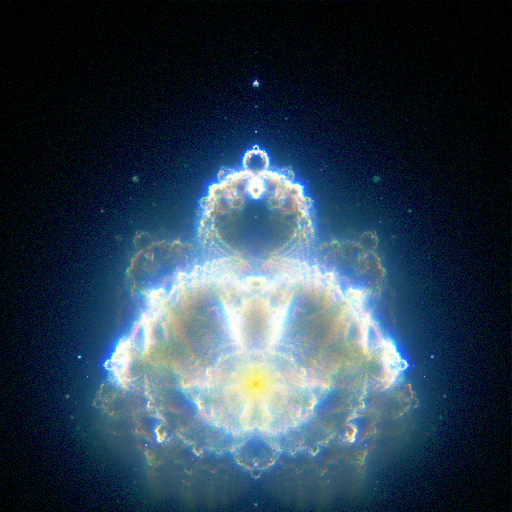
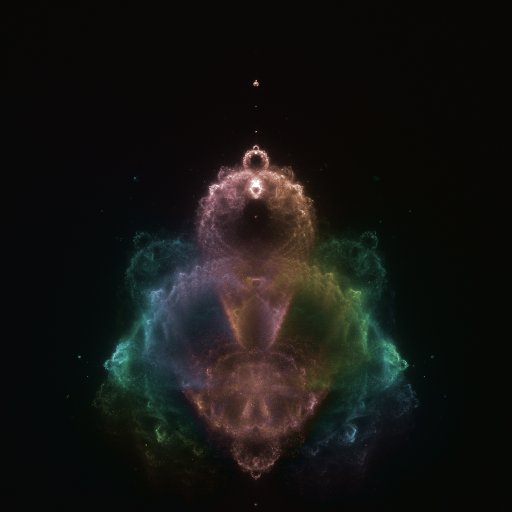
The most common way to color the Buddhabrot is to use renders at three iteration caps as the color channels of one image: here red is the 10,000-iteration render, green 500, and blue 100, balanced with histogram equalization. It is the same trick used for false-color astronomy photos, where each channel is a different wavelength of light. This is the idea Melinda Green used to develop her famous view of the Buddhabrot -- you can read more on her website, and many thanks to her for help on rendering the "Traditional" view presented here.
The alternative used for the "Escape Coloring" view sums the value of c
itself into every pixel an orbit touches. The complex argument of each pixel's sum
then picks a hue and its magnitude the brightness, through a palette slightly muted
from a traditional HSV ramp to even out perceptual brightness -- and because it
looks better.
Each view is computed at the full 220 resolution from roughly 6.8 quadrillion random sample orbits -- 3.46 x 10¹³ per 5,376-row band, 196 bands -- with each orbit followed for up to 500,000 iterations. A Buddhabrot pixel collects visits from starting points all over the plane, so every band re-throws the full sample budget; the work ran on a small fleet of computers, all depositing bit-identical results. The result is about 16.8 million 256-pixel tiles per view plus their zoom pyramid, served here through OpenSeadragon.
The sample images on this page were generated at small scale by the same coloring code as the full render.